

For months, we’ve been building toward this moment. Last month, we introduced Metadata - the foundation for understanding and organizing your firm’s data.
Today, we’re introducing Agents - launching Monday, January 5, 2026 - the foundation for intelligent, autonomous decision-making.
Together, they transform how AI works in your firm.
The Problem with Today’s AI
Most AI tools work the same way: you ask a question, the system searches, and it returns results. It’s fast, but it’s reactive. It doesn’t think. It doesn’t reason. It doesn’t understand context.
For architecture and engineering firms, that limitation is costly.
A structural engineer searching for seismic design requirements has to manually decide: Do I search “codes,” “standards,” or “geotechnical”? Each search might require a different index. Each answer is only as good as the search terms used.
A project manager drafting a status report pulls from a schedule, email threads, and meeting notes - manually stitching together context that should be automatic. That’s five hours of work when it should be one.
A proposal manager assembles RFP responses by bouncing between project files, resumes, and past proposals - each context switch burning time and introducing errors.
The core issue: Today’s AI doesn’t know how to think about your firm’s problems. It just searches. And it requires your team to understand your firm’s complex index architecture just to get a good answer.
What Agents Change
Agents are AI that thinks.
In HallianAI Version 6.0.0, we’re introducing agents as a straightforward evolution of what you already know. If you’ve built AI Assistants in HallianAI, you understand the foundation. Agents are the next step.
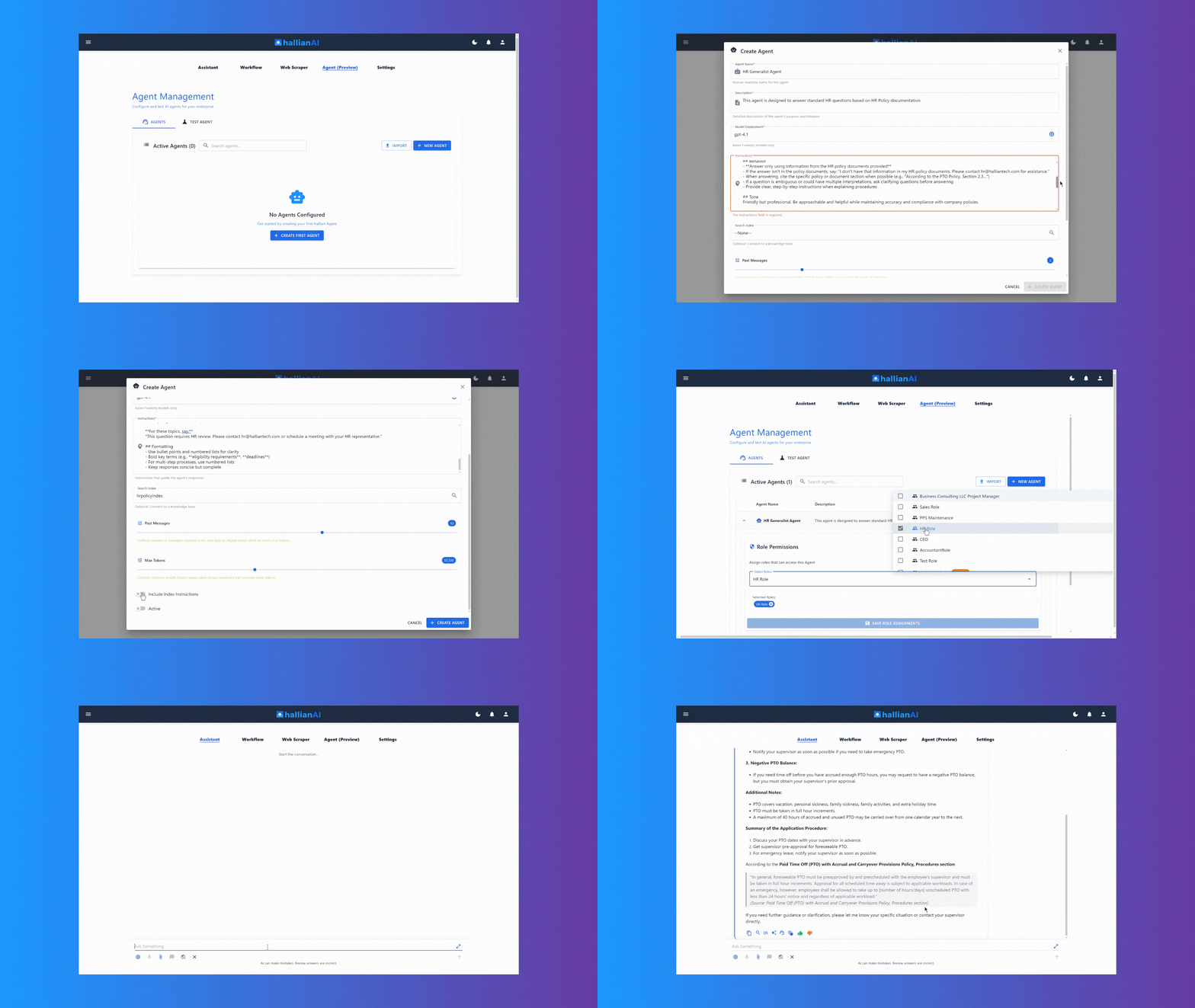
Current AI Assistant Model
- Instructions live on the index
- Assistant searches that index
- Responses are based on index content + index instructions
- Limitation: Users must know which indexes to search
New Agent Model
- Instructions live on the agent (independent)
- Agent can couple with an index (optional)
- Agent follows its own instructions while searching index content if provided
- Agent accesses conversation memory in a more compelling way, making conversations feel more intuitive, continuous, and natural for users
Result: Richer, more context-aware conversations with deeper continuity - without requiring users to understand your firm’s index architecture.
By separating agent instructions from index instructions, you gain control over how the agent thinks. An index provides data context (“Here’s what’s in this knowledge base”). An agent provides behavioral context (“Here’s how I should reason about that data and what I should do with it”).
This seemingly small change unlocks everything.
Building on Your Foundation
You’ve already invested in the infrastructure that makes agents powerful:
- Indexes: Organized your firm’s knowledge
- Workflows: Automated your processes
- Metadata: Structured your data
- Agents intelligently leverage all of these.
Agents don’t replace indexes, workflows, or metadata. They use them.
What’s Coming in 2026
Agents are the foundation for a generation of capabilities coming throughout 2026:
- Agentic RAG: Agents automatically select which indexes to search based on the question - no more manual guessing
- Metadata System Logic: Agents filter and reason over structured metadata (dates, vendors, project types) like a database would
- Advanced Tool Calling: Agents call external APIs, trigger workflows, and execute multi-step operations
- Enhanced RAG 2.0: Agents prioritize results based on metadata first, then context - smarter, faster search
- Agent Orchestration: Agents working together to provide even better results by combining specialized reasoning
Real-World Impact
For Structural Engineers: Instant Access, No Training Required
- Today: Junior engineer spends 2 hours searching multiple indexes for seismic design details.
- With Agents: Describe the site conditions to a Structural Design Agent. The agent automatically uses the right indexes and generates a complete design recommendation in 30 minutes.
- Impact: Hundreds of billable hours reclaimed annually per firm.
For Project Managers: Context Assembly Becomes Automatic
- Today: PM manually pulls data from schedule, emails, contracts, meeting notes to write status reports (5+ hours per cycle).
- With Agents: Agent assembles everything, generates draft in your firm’s format (1 hour). PM reviews, tweaks, sends.
- Impact: For a 50-project firm, 1,000+ hours reclaimed annually.
For Proposal Teams: RFP Responses in Hours, Not Days
- Today: Marketer chases engineers, digs through shared drives, reassembles information (2 days).
- With Agents: Agent identifies relevant projects, generates team bios, drafts response (4 hours).
- Impact: 75% reduction in cycle time. Higher quality. Higher win rates.
Why This Matters to Your Firm
Your competitive advantage is your people - your senior engineers, your experienced PMs, your technical depth. But today, much of their time is spent on repetitive, low-value work: searching for information, writing reports, stitching together context.
Agents eliminate that friction.
For Your Bottom Line
- Reduced admin overhead: 40-70% reduction in high-value staff admin time on targeted workflows
- Higher billable utilization: More hours on billable work, fewer on repetitive admin
- Faster project delivery: Quicker access to information means faster decisions
- Better proposals: Smarter RFP responses - higher win rates - more revenue
- Knowledge preservation: Institutional expertise captured before senior staff retire
The Bigger Picture
Six months ago, we introduced Metadata - the foundation for understanding and organizing your data.
Today, we’re introducing Agents - the foundation for autonomous, intelligent decision-making.
This is the beginning of something significant. Questions? Contact us for a personalized demo.
The agent revolution starts January 5.


